
Published on 07 July 2026
Teaching Students Who Seem Unreachable
How stress affects learning, and how steady teaching helps
____________________________________________________________________________________________________________________________________________________________________________________
Some students enter the classroom carrying much more than just books and pens. They arrive weighed down by anxiety, exhaustion, family obligations, financial strain, or the lingering scars of past academic failures. Many are fighting a quiet, persistent inner voice that whispers, “Maybe I’m just not good at this.”
These challenges rarely appear as a clear cry for help. More often, they show up as silence, a difficult attitude, missed deadlines, blank stares, or a student sleeping through class. It is easy to mistake these behaviors for disinterest or defiance. In reality, the student may deeply want to learn and succeed, but their brain and body are focused on something more basic: feeling safe.
Overwhelmed students are not unteachable; they are just temporarily unavailable for learning.
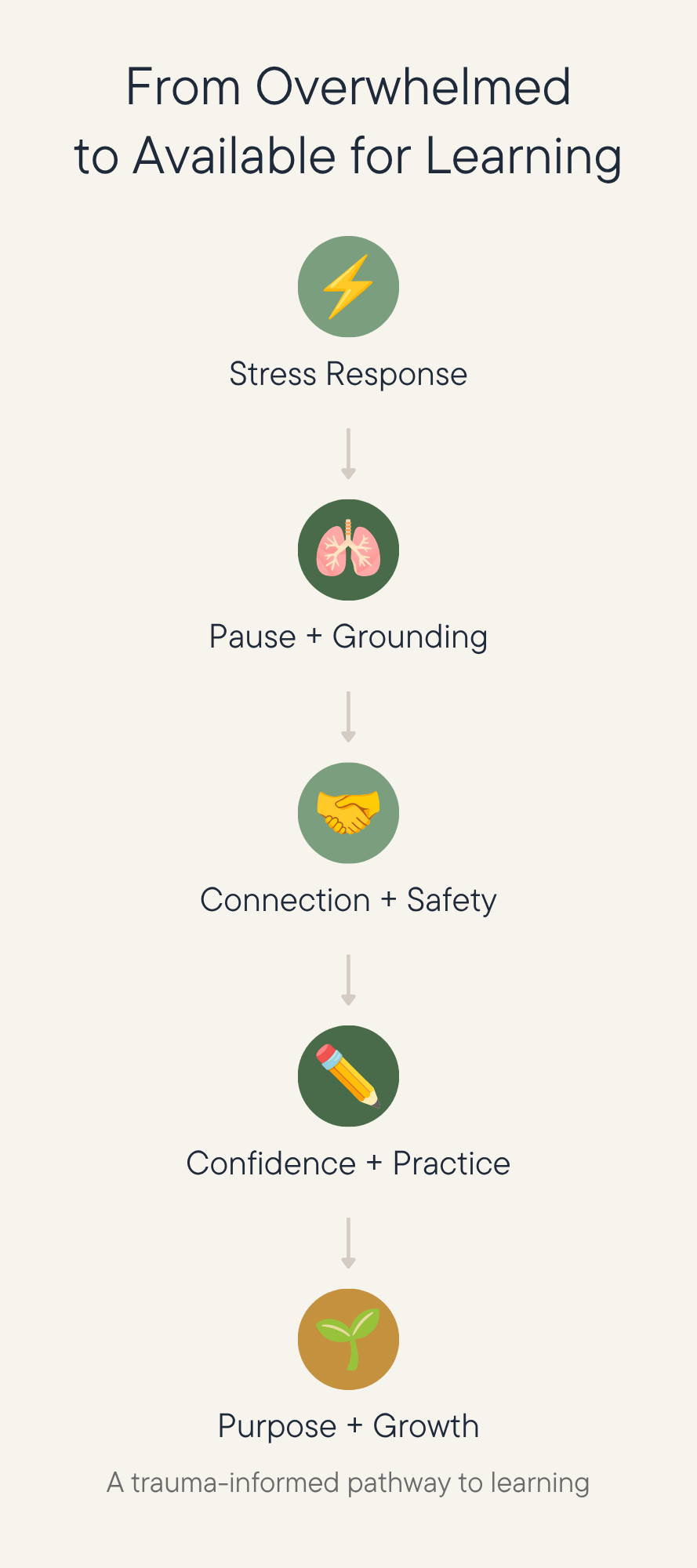
Click the infographic to view the full-size image.
The Science of Stress in the Classroom
Unfortunately, trauma and chronic stress fundamentally alter how a person processes information. When the nervous system senses a threat, the brain automatically prioritizes survival over everything else. It scans the room for danger, preparing the body to fight, flee, freeze, or shut down. While this response is lifesaving in an emergency, it is completely counterproductive when trying to read, take a test, practice a skill, or retain instructions.
When a student is chronically stressed:
Information doesn’t stick: They might hear your words, but the brain doesn’t absorb them.
Memory cuts out: They can study for hours, only for their mind to go completely blank during a quiz.
Consistency disappears: They might fully grasp a concept today and then have no memory of it tomorrow
Underneath the frustrating behavior isn’t a bad attitude, it’s a nervous system working overtime.
Settle the Body, Clear the Mind
How do we break this cycle? We start by helping students come back to themselves.
This doesn’t mean educators need to act as therapists, nor does it mean lowering classroom standards. It simply means recognizing that learning isn’t just an intellectual exercise; it’s a whole-person experience. A student’s physical body, emotional state, attention span, relationships, and sense of purpose all sit in the room with them.
Before a student can think critically, they often need help settling their nervous system. This can start with small, practical tools:
- Taking one deliberate, steady breath.
- Placing both feet firmly on the floor to ground themselves.
- Intentionally pausing before answering a question.
- Noticing physical tension in the shoulders or jaw.
- A gentle reminder that a mistake is a step forward, not a disaster.
These practices take less than a minute, but they can fundamentally shift a student’s capacity to learn.
Impact Across Generations
For young scholars, introducing these habits early builds foundational self-awareness. A young person who learns to name their stress, pause before reacting, and try again after a setback is gaining far more than academic knowledge, they are building vital life skills.
For adult learners, this approach can heal deep-seated wounds regarding their own intelligence. Many adults return to the classroom carrying heavy narratives: “I was never good at school,” or “I’m too old to learn new things.” When they realize that stress is what’s hijacking their memory and focus, something shifts. A personal struggle stops looking like proof of failure and starts looking like valuable information.
Posture, Presentation, and Rewriting the Narrative
We also cannot overlook the physical connection to learning. How a student sits, breathes, speaks, and enters a room shapes how they feel. Sometimes, practicing a steadier posture, a calmer voice, or a slower breath is exactly what provides the courage to try again.
It helps to consider how many students who appear resistant are just protecting themselves from shame. If they have been embarrassed in a classroom before, they may have decided it’s safer to pretend they don’t care than to try and fail in front of their peers.
This is why an educator’s response is so critical. A teacher has the power to turn a mistake into a wall or a doorway. A failed quiz can be met with, “You didn’t study enough,” or it can be met with, “Now we have a clear map of what to practice next.” The curriculum is the official lesson, but our response is what they actually learn.
Ultimately, we have to help students rewrite their internal scripts:
- “This assignment is too hard, I’m stupid” becomes “This is new to me.”
- “I don’t understand this, I don’t belong here” becomes “I just need more practice.”
A Different Way In
Purpose is the final piece of the puzzle. Students don’t persevere for a line on a resume or a letter grade; they keep going when they realize that learning changes how they see themselves and what they are capable of achieving.
The student who seems unteachable is usually just waiting for a different entrance into the material. When we help them settle their bodies, understand their stress, build genuine confidence, and reframe failure, we do far more than teach a subject. We help them step into their own future.
____________________________________________________________________________________________________________________________________________________________________________________
ABOUT THE AUTHOR
Tracy Morrow believes that learning is a deeply human experience shaped by stress, connection, and the nervous system. As a professional trainer certified in coaching, meditation, and mindfulness practices, she specializes in trauma-informed learning and practical resilience. Through her work with the Brainstorming Network Group, Tracy focuses on creating collaborative, human-centered spaces for leadership, education, and personal growth. You can learn more at OmLifeLab.com
____________________________________________________________________________________________________________________________________________________________________________________