
Published on 02 February 2026
Teaching with intention: Educators can never be overdressed or overeducated
____________________________________________________________________________________________________________________________________________________________________________________
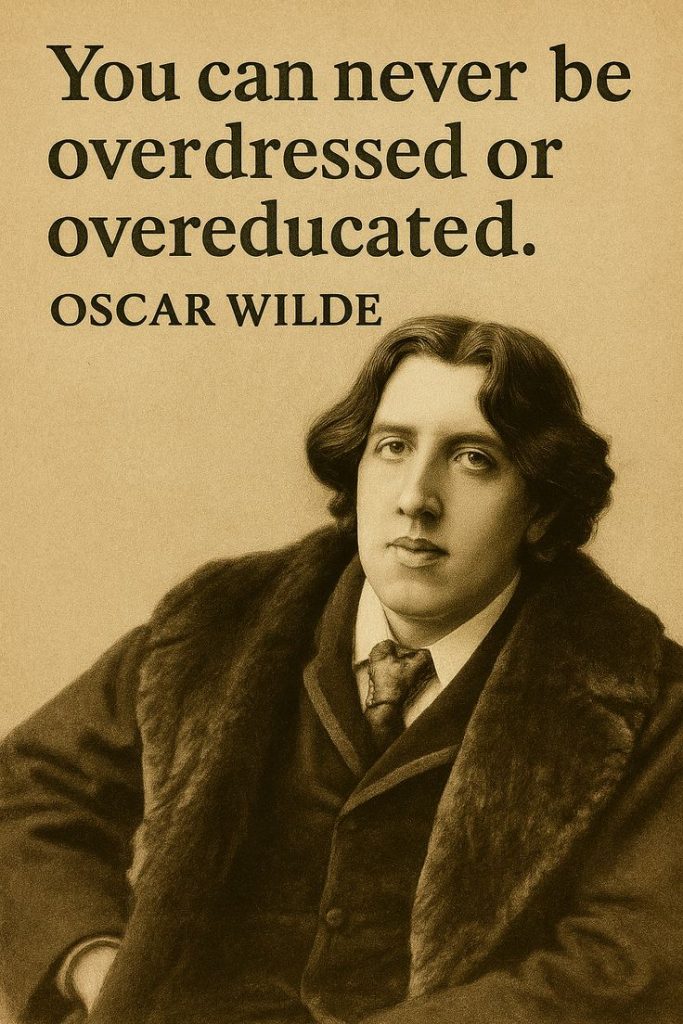
Oscar Wilde’s claim that one can ‘never be overdressed or overeducated’ resonates in teaching because it speaks directly to professional responsibility. In mainstream schools, how teachers present themselves and how deeply they engage with knowledge shape students’ expectations of learning before any lesson begins. The quote captures a core educational principle: teaching is not value-neutral work, but a profession in which credibility, care, and intellectual seriousness are communicated through visible, sustained professional choices.
Professional presence as pedagogical practice
In mainstream classrooms, professional presence functions as an immediate pedagogical signal. Attire, demeanour, and preparedness communicate seriousness of purpose and respect for the learning environment. This is not a call for expensive clothing or rigid formality. Professional dress reflects sound judgement: being well-presented, appropriate, and clearly aligned with the expectations of a profession rather than the casual codes of a hobby or leisure activity.
Professional presence also requires rejecting the idea that teachers must appear ‘cool’, fashionable, or peer-like to connect with students. Regardless of age, authority and trust are built through consistency, clarity, and competence, not trend alignment. Students respond more reliably to calm authority, predictable routines, and clear boundaries than to attempts at cultural imitation or informality designed to impress.
These choices shape behaviour and engagement across lessons. During assessments, a teacher who maintains a focused, attentive presence supports concentration and reduces anxiety. In discussion-based lessons, measured tone, purposeful movement, and clear facilitation signal that listening, thinking, and respectful contribution are expected. Professional presence frames learning as serious without being severe, and structured without being rigid.
Intellectual depth as professional obligation
If professional presence reflects respect for learners, intellectual depth reflects respect for the profession. To be overeducated is not to accumulate qualifications for display, but to remain intellectually engaged in a complex and evolving field. In mainstream schooling, this involves understanding curriculum progression, evidence-informed pedagogy, and age-appropriate cognitive demand across subject areas.
Intellectual depth is most visible in instructional judgement. Effective formative assessment, for example, is not a collection of techniques but a professional skill requiring interpretation, responsiveness, and adjustment. Teachers who identify misconceptions, refine explanations, and revise lesson flow in response to student understanding demonstrate intellectual engagement rather than procedural compliance.
Intellectual depth also shapes how knowledge is positioned in classrooms. Teachers who explain their reasoning, justify pedagogical choices, and invite students to revise thinking model learning as an iterative process. This communicates that learning prioritises process over product, depth over breadth, and sustained thinking over surface-level completion, regardless of student age or subject area.
Summary
Oscar Wilde’s assertion that one can ‘never be overdressed or overeducated’ functions, in teaching, as a statement of professional responsibility rather than personal preference. In mainstream schools, professional presence and intellectual depth shape how students understand learning, authority, and care long before content is delivered. The quote reminds educators that teaching communicates values continuously, through conduct, preparation, and intellectual engagement.
To be overdressed is to show respect for learners and for the work of teaching, not to display status or cost. Teachers do not need to be cool; they need to be credible. To be overeducated is to uphold the profession through curiosity, judgement, and intellectual integrity. This represents professional strength rather than excess. Together, these commitments define teaching as disciplined, ethical practice.
____________________________________________________________________________________________________________________________________________________________________________________
ABOUT THE AUTHOR

Dr Donna M. Velliaris is a globally recognised educator, author, and practitioner-scholar whose work advances inclusive, high-impact teaching and learning across diverse educational contexts. She holds three Master’s degrees in Educational Sociology, Studies of Asia, and Special Education, a PhD in Education, and a Postdoctoral Fellowship. A three-time Top 30 Global Guru in Education, she ranks among the leading voices shaping contemporary education discourse. Dr Velliaris is the author of eight books, with four further titles in development, and has contributed over 40 book chapters. Her work reaches a global audience through widely used digital platforms and professional learning resources.
____________________________________________________________________________________________________________________________________________________________________________________